

Shopify ecommerce development can cost from a modest five-figure budget in India for a focused theme-based launch to several lakhs for a custom storefront, migration or integration-heavy build. The exact amount depends less on the number of pages than on design originality, catalogue complexity, data quality, customer journeys, apps, integrations, testing and post-launch responsibility. Two stores with the same product count can have very different budgets if one uses standard Shopify behaviour and the other requires subscriptions, wholesale pricing, an ERP connection or custom merchandising tools.
A useful budget separates three categories: Shopify platform charges, third-party expenses and professional implementation fees. Shopify publishes its current plan and transaction information, while themes and apps have their own commercial terms. Design and development charges are quoted by the provider according to scope. Combining these categories into one headline figure makes proposals difficult to compare and hides the real cost of ownership.
This guide provides indicative Indian planning ranges for 2026, not fixed quotations. Prices exclude applicable taxes unless a proposal says otherwise, and third-party prices should be verified directly before purchase. The goal is to help you build a realistic brief, understand cost drivers and evaluate value without choosing purely on the lowest estimate.
Shopify eCommerce Development Cost India
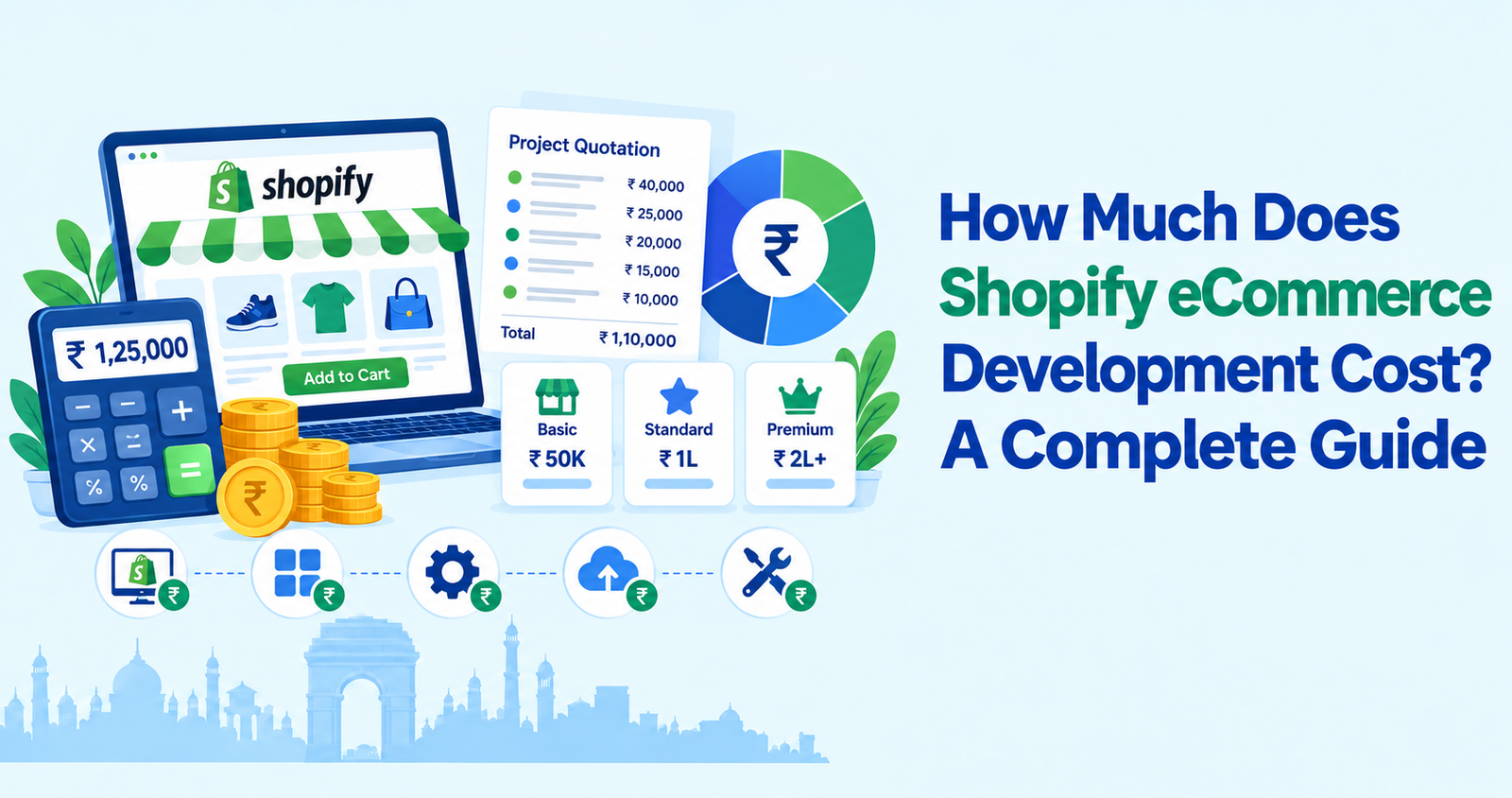
For planning purposes, a lean Shopify store in India may require about ₹35,000 to ₹80,000 in professional setup and customisation. A professionally designed small or mid-sized store may fall around ₹80,000 to ₹2,50,000. A custom theme, complex migration or integration-led project can range from roughly ₹2,50,000 to ₹8,00,000 or more. Shopify Plus, headless commerce, advanced B2B and multi-system programmes commonly require individual discovery and can extend well beyond these bands. Add Shopify subscription, theme, app, domain, payment, content, support and internal operating costs separately.
REQUEST A SCOPE BASED ESTIMATE | Share catalogue size, design expectations, required features, integrations, content readiness and target launch date.
Shopify Cost at a Glance
| Project type | Indicative development range in India | Typical scope |
| Starter theme setup | ₹35,000 to ₹80,000 | Theme configuration, essential pages, products, navigation, payments, shipping and basic QA |
| Professional branded store | ₹80,000 to ₹2,50,000 | UX planning, stronger visual system, custom sections, collection and product improvements |
| Custom Shopify theme | ₹2,50,000 to ₹6,00,000+ | Bespoke design system, reusable Online Store 2.0 sections, advanced storefront behaviour |
| Migration to Shopify | ₹1,00,000 to ₹5,00,000+ | Data mapping, imports, redirects, validation and controlled launch |
| Integration led build | ₹2,00,000 to ₹8,00,000+ | ERP, CRM, warehouse, POS, marketplace or custom API workflows |
| Shopify Plus or headless | Discovery based | Enterprise requirements, custom architecture, B2B, international or high-complexity delivery |
These bands overlap because scope matters more than the label. A small catalogue with an unusual product configurator may cost more than a large catalogue imported from clean structured data. Use ranges to set expectations, then request a written estimate based on requirements.
Separate Platform Cost from Development Cost
Shopify charges for access to its hosted commerce platform. A developer or company charges for strategy, design, configuration, coding, migration, integration, testing and support. These are separate. Shopify states that its plans have no setup fee, while third-party transaction fees may apply when a third-party payment provider is used; rates and feature availability can vary by plan and country. Merchants in India should verify the current pricing page, available payment options and provider terms before committing.
Your recurring platform budget can include a Shopify plan, domain, paid theme, paid apps, email or SMS services, third-party search, subscriptions, returns software, shipping tools and integration middleware. Development fees are usually one-time, milestone-based or time-based, while maintenance and optimisation may be retained monthly.
A proposal should show each category separately. If a provider includes the first year of an app or theme, confirm who owns the licence and what renewal costs apply. Avoid assuming that a development quotation covers Shopify’s subscription or payment-processing charges.
BUILD A THREE PART BUDGET | Track platform, third-party and professional-service costs in separate columns.
Shopify Subscription and Transaction Expenses
Choose a Shopify plan according to current operational needs rather than anticipated prestige. Staff access, reporting, shipping capabilities, international requirements and transaction economics can influence the decision. A growing merchant can generally change plans later, so the most expensive option is not automatically the best starting point.
Payment costs are operational expenses, not development charges. They can include payment-provider processing fees and, depending on the plan and payment route, Shopify third-party transaction fees. Availability differs by country. Review settlement cycles, refunds, chargebacks, supported payment methods, COD workflows and reconciliation with the chosen providers.
Because plan prices and promotions change, this article does not freeze them into the development bands. Verify the live Shopify pricing page at procurement and again before launch. Record whether displayed prices are monthly or annual, which currency applies and whether taxes are additional.
VERIFY LIVE COMMERCIAL TERMS | Capture the selected plan, billing cycle, payment provider and expected transaction model in the budget.
Theme Cost and Theme Based Development
A Shopify theme supplies templates, components and settings. Free themes can be suitable when the business accepts their design system and required features. Paid themes may offer additional layouts or merchandising tools, but the purchase price does not include professional configuration, content setup, brand adaptation or custom development.
Theme-based projects are economical when the selected theme already supports most requirements. Costs rise as the provider changes headers, menus, product cards, collection filtering, product information, cart behaviour and mobile layouts. Heavy modification can make a theme difficult to update, so the company should explain when focused customisation is appropriate and when a custom build becomes more responsible.
Budget separately for theme research, licence purchase, configuration, design adaptation, custom sections, QA and future theme updates. Confirm that the licence is purchased in the merchant’s account and that preview testing occurs before purchase where the store permits it.
CHOOSE THE THEME AFTER REQUIREMENTS | Compare native capabilities with the actual customer journeys before paying for custom changes.
Custom Shopify Theme Development Cost
Custom Shopify theme development is appropriate when the brand needs a distinctive component system, specialised merchandising or workflows that standard themes cannot support cleanly. The work may include discovery, information architecture, wireframes, visual design, responsive states, reusable sections, Liquid development, JavaScript behaviour, metafields, accessibility checks, performance review and merchant training.
The number of unique templates matters more than the number of URLs. A store may need separate product templates for different categories, editorial collection layouts, campaign landing pages, complex navigation and flexible content modules. Every component must be designed for real data, mobile behaviour and editor controls. Review and revision rounds also affect the estimate.
A custom theme should not mean that every element is hard-coded. The investment should produce maintainable, merchant-editable components. Ask for a component inventory and identify which features remain native, which use apps and which require custom code.
PRICE THE COMPONENT SYSTEM | Count unique templates, states and reusable sections instead of estimating by page count alone.
Product Catalogue and Merchandising Costs
Catalogue effort depends on data structure and quality. Product titles, descriptions, media, variants, options, prices, inventory, SKUs, barcodes, categories, tags, metafields and SEO data may require cleaning before import. A catalogue with 2,000 consistent records can be easier than 100 inconsistent products assembled from spreadsheets, messages and old pages.
Advanced filters, product bundles, subscriptions, personalised products, size guides, comparison tools, swatches, back-in-stock alerts and related-product logic add configuration or development. Shopify Search and Discovery may cover common filtering requirements, while specialised search or merchandising can introduce app costs.
Clarify who enters products, crops images, writes copy, assigns collections and validates variants. Content population is frequently excluded from development proposals. A sample-data audit lets the provider estimate automation, manual correction and business review more accurately.
AUDIT PRODUCT DATA EARLY | Provide sample records, variant rules, filters and merchandising requirements before final pricing.
Shopify Store Design and UX Cost
Design cost varies with originality and depth. A basic project may adapt theme typography, colour, imagery and layout. A more involved engagement can include stakeholder discovery, competitor review, navigation planning, wireframes, design concepts, responsive screens, component states, prototypes and usability review.
Ecommerce UX covers product discovery, search, filters, product detail, variants, trust information, cart feedback, forms and support content. Designing only a homepage underestimates the work. Mobile states, long content, sale prices, unavailable variants and error messages should be considered before development.
Brand assets influence the budget. If photography, illustration, iconography, copywriting or a visual identity is incomplete, those services require time and specialist input. Stock assets may reduce production cost but still need licensing and art direction.
DEFINE DESIGN DELIVERABLES | Specify templates, breakpoints, component states, revision rounds and responsibility for brand assets.
Shopify Migration Cost
Migration cost is driven by source-platform access, data volume, field complexity, URL changes and feature replacement. Products, customers, orders, pages, blogs, reviews, gift cards, discounts and custom data may not transfer in the same way. Customer passwords often require a different activation process. Legacy extensions may need Shopify apps or custom alternatives.
A responsible migration includes data mapping, trial imports, exception handling, reconciliation and final cutover. Organic search continuity adds URL inventory, redirects, internal-link updates, metadata review and post-launch monitoring. Analytics and pixels also need validation.
Budget can increase when source data is duplicated, incomplete or embedded in custom tables. Ask for a sample migration before fixing the final estimate. The proposal should state record types and quantities, excluded cleanup, redirect approach, freeze window and responsibility for final validation.
PRICE MIGRATION AFTER SAMPLING DATA | Use real exports to expose cleanup, mapping and feature gaps before launch.
App and Plugin Costs
Shopify apps can add reviews, loyalty, subscriptions, bundles, search, automation, feeds, returns and reporting. Charges may be free, one-time, monthly, tiered by usage or based on orders, contacts or revenue. The visible subscription is only part of the cost; apps also require evaluation, configuration, styling, testing and future monitoring.
Before adding an app, compare Shopify’s native features, the theme, a reputable app and custom development. Record the purpose, owner, permissions, recurring fee, data stored, removal impact and alternative. Multiple apps that alter the same area can create conflicts or performance overhead.
Annualise app fees when comparing proposals. A ₹3,000 monthly stack becomes ₹36,000 each year before tax or usage growth. Custom code can avoid a subscription in some cases, but it introduces build and maintenance costs. Choose according to total ownership cost and business risk.
CREATE AN APP REGISTER | Document commercial terms, permissions, storefront impact and exit risk for every selected app.
API and Third Party Integration Costs
Integrations with ERP, CRM, POS, warehouses, couriers, marketplaces, accounting or loyalty systems can be among the largest cost drivers. Pricing depends on API quality, authentication, data volume, direction of flow, update frequency and failure handling. A simple customer export is not comparable to near-real-time inventory, order, fulfilment, cancellation and refund synchronisation.
Discovery should identify the source of truth, identifiers, field mapping, rate limits, retries, duplicate prevention, alerts and ownership when an external system is unavailable. Middleware can shorten development but adds recurring fees. Direct custom integration can provide control but requires maintenance when APIs change.
Third-party vendors may charge onboarding, sandbox or support fees. Include their response time and access dependencies in the project plan. A fixed integration quote without documentation or sample access usually carries hidden assumptions.
Technical SEO Performance and Accessibility Costs
Shopify provides useful hosted foundations, but implementation still affects crawl paths, titles, internal links, structured content, redirects, image handling and page experience. Technical SEO work can include architecture review, template rules, metadata patterns, collection strategy, redirect mapping and analytics validation. It should not be confused with ongoing content production or link acquisition.
Performance work may involve image strategy, fonts, JavaScript, apps and third-party scripts. Ask which representative templates will be measured and what trade-offs are accepted. No provider should guarantee a perfect score because real content, devices, networks and external tools influence results.
Accessibility includes semantic structure, keyboard use, focus visibility, labels, alternatives, contrast and interaction states. A formal audit or remediation programme costs more than basic development checks. Define the intended standard and test depth in the scope.
MAKE QUALITY MEASURABLE | Agree SEO, performance and accessibility deliverables instead of relying on vague claims.
Content Photography and Product Setup Costs
A store cannot launch well with incomplete inputs. Product photography, editing, video, copywriting, policy pages, translations, size charts and collection descriptions may sit outside the development estimate. Internal teams also spend time approving designs, preparing data and testing workflows. These are real project costs even when no supplier invoice is raised.
Create a content matrix showing each template, required asset, owner and deadline. Decide whether the development company will populate all content, provide a limited sample or train the merchant team. Content entry can be priced per item, by time or within a capped quantity.
Delays commonly arise when product data, payment verification, shipping rules or policies are not ready. A lower development quote does not compensate for an unplanned content workstream.
BUDGET FOR CONTENT READINESS | Assign owners for copy, media, product data, policies and approvals at project start.
Testing Launch and Training Costs
Quality assurance covers browsers, devices, navigation, search, filters, product options, pricing, discounts, cart, accounts, forms, shipping communication, payment preparation, notifications, analytics and error states. Migrations and integrations require additional reconciliation. The broader the supported combinations, the greater the effort.
Launch work can include domain and DNS coordination, redirects, final imports, app activation, analytics checks, staff readiness and a defined monitoring window. User acceptance testing is a shared responsibility: business owners must confirm prices, policies, tax inputs, fulfilment and customer communication.
Training may be delivered live, through recordings or written documentation. Budget for the internal roles that will manage products, orders, promotions and content. Good handover reduces dependence on the original provider and lowers future operating cost.
INCLUDE LAUNCH IN THE SCOPE | Define test coverage, sign-off owners, cutover tasks, hypercare and training deliverables.
Ongoing Maintenance and Optimisation Cost
Post-launch services can be sold hourly, as prepaid capacity, through a monthly retainer or as fixed improvement projects. A basic maintenance arrangement may cover small fixes and platform changes. A growth retainer may add analytics review, UX improvements, landing pages, merchandising support and controlled releases.
Ask what qualifies as a defect, the warranty period, response hours, severity levels and whether unused capacity rolls over. Emergency or weekend work may have different terms. App updates, theme upgrades and third-party changes can create work even when the merchant requests no new feature.
A sensible annual plan reserves budget for operational support and evidence-led improvements. The amount depends on change frequency, campaign calendar, integration risk and internal capability. Avoid retaining more capacity than the team can brief and approve.
PLAN THE FIRST YEAR NOT ONLY LAUNCH | Include support, licences, app renewals and a realistic improvement reserve.
Hidden and Frequently Missed Costs
- Applicable taxes, currency conversion and international card charges.
- Premium theme, font, image, icon, video or other asset licences.
- App usage tiers that increase with orders, contacts, locations or revenue.
- Product-data cleanup, image resizing, copywriting and translation.
- Payment-provider onboarding, processing, refund and chargeback expenses.
- Domain, email, SMS, consent, analytics, feed and middleware services.
- Change requests caused by late requirements or additional approval rounds.
- Migration cleanup, redirect mapping and post-launch search monitoring.
- Internal staff time for content, decisions, testing, training and operations.
- Future theme updates, app conflicts, API changes and specialist support.
Ask every supplier to state exclusions and third-party assumptions. Hidden cost is often work that was never discussed rather than a deliberately concealed charge.
KEEP A CONTINGENCY | Reserve roughly 10 to 20 percent for validated changes and uncertainty, adjusted to project complexity.
Practical Shopify Budget Examples
| Business situation | Illustrative first build budget | Major cost components |
| Small Delhi D2C launch | ₹50,000 to ₹1,00,000 | Theme setup, focused branding, initial catalogue, payments, shipping and QA |
| Established retailer redesign | ₹1,25,000 to ₹3,00,000 | UX, custom sections, navigation, filters, product pages, redirects and analytics |
| Fashion or beauty catalogue | ₹1,50,000 to ₹4,00,000 | Variants, swatches, media, filters, reviews, merchandising and mobile UX |
| WooCommerce migration | ₹1,50,000 to ₹5,00,000+ | Data mapping, import, feature replacement, redirects, cutover and validation |
| B2B or wholesale workflow | ₹3,00,000 to ₹10,00,000+ | Customer-specific logic, catalogues, integrations, testing and governance |
| International or headless programme | Discovery based | Markets, content, architecture, frontend, APIs, infrastructure and ongoing engineering |
These examples exclude Shopify subscription, payment processing and third-party recurring charges. Actual quotes may fall outside the bands when requirements are simpler or materially more complex.
SELECT THE CLOSEST SCENARIO | Use it only as a starting point, then adjust for data, design, integrations and operational risk.
How to Compare Shopify Development Quotes
| Quotation area | What to compare | Common warning |
| Scope | Templates, features, quantities and deliverables | Generic line such as complete website |
| Assumptions | Data, content, access, licences and client responsibilities | Important dependencies omitted |
| Exclusions | SEO, migration, apps, integrations, content, QA and support | Included without definition |
| Commercial model | Fixed price, time based, retainer, milestone and tax terms | Low total without rate or limits |
| Recurring cost | Plan, theme, apps, middleware and services | Only first month shown |
| Change control | How new work is estimated and approved | Unlimited revisions promise |
| Acceptance | Review criteria, testing and defect process | Completion based only on launch |
| Ownership | Store, accounts, code, assets, licences and documentation | Provider controlled merchant accounts |
Normalise proposals in a spreadsheet and compare the same requirement. A higher quote may include discovery, migration validation, responsive design, QA and training that a lower quote excludes. Ask providers to resolve ambiguous lines before awarding the work.
How to Control Cost Without Damaging Quality
Prioritise launch essentials and move uncertain enhancements to a later backlog. Use Shopify’s native features where they meet the requirement. Select a theme after checking customer journeys, limit app overlap and clean product data before migration. Approve a component system rather than redesigning each page independently.
Keep one decision owner, provide consolidated feedback and respect review windows. Freeze major requirements before development while retaining formal change control. Validate risky integrations or migrations through a paid discovery task or prototype. These actions reduce rework more effectively than simply negotiating the provider’s rate.
Low cost becomes expensive when it creates dependency, weak ownership or fragile custom code. Spend first on the areas where failure would affect customers, revenue operations, data or organic traffic. Defer decorative enhancements that have no clear customer or business purpose.
Fixed Price Hourly Retainer and Dedicated Team Models
The commercial model changes how risk is shared. A fixed-price engagement works best when deliverables, assumptions and acceptance criteria are stable. The provider includes a margin for uncertainty and manages work within the agreed boundary. New requirements move through change control. Fixed price gives budget visibility, but it does not make an unclear project predictable; ambiguity is usually converted into exclusions or contingency.
Hourly or time-and-materials pricing is useful when priorities will evolve, an existing store contains unknown issues or work must be investigated before a solution is known. The merchant pays for actual time, so reporting, rate cards, estimates and approval limits become important. Ask how time is recorded, who can authorise work and whether unused estimates carry any commitment.
A monthly retainer provides planned access to design, development or optimisation capacity. It can support campaigns, maintenance and a prioritised backlog, but value depends on the business being able to brief, approve and release work consistently. Confirm included roles, capacity, response terms, rollover rules and exclusions. A dedicated team suits larger programmes with continuous demand, multiple systems and internal product leadership; it normally carries a higher ongoing commitment.
Some projects use a hybrid: fixed-price discovery, fixed implementation milestones and a support retainer after launch. Compare the expected total under realistic change, not merely the advertised hourly rate. A senior specialist may solve a problem faster than a low-rate generalist, while an agency may cost more but provide coordinated design, engineering and QA.
Calculate the First Year Total Cost of Ownership
A first-year calculation gives a more accurate view than the launch invoice. Start with one-time professional work: discovery, design, development, migration, integration, content support, testing and training. Add one-time third-party purchases such as a premium theme or asset licences. Then annualise the Shopify plan, apps, middleware, domain, email, SMS, search, returns and other subscriptions. Add anticipated maintenance, enhancement and internal staff time.
Transaction and payment-processing expenses should be forecast from expected sales, average order value, refund rate and provider terms. Keep these separate because they scale with commercial activity rather than development effort. If costs are billed in another currency, allow for conversion and price changes. Apply taxes according to the invoice and your adviser’s guidance.
| First year cost category | Planning method | Budget owner |
| Initial build | Accepted proposal plus approved contingency | Project or ecommerce lead |
| Platform and domain | Current plan and renewal terms multiplied by billing period | Finance or operations |
| Theme apps and middleware | One-time licences plus 12 months of recurring fees | Ecommerce and technology |
| Payments and transactions | Forecast order value and volume against current provider terms | Finance |
| Content and internal effort | Supplier fees plus realistic staff allocation | Marketing and operations |
| Support and improvements | Warranty, retainer, hourly reserve and roadmap projects | Ecommerce owner |
Review the model against a lean, expected and high-growth scenario. This reveals costs that rise with volume and prevents app or middleware tiers from becoming a surprise. Revisit the model after launch with real usage and remove tools that do not create enough operational or customer value.
COMPARE YEAR ONE NOT DAY ONE | Use one-time, recurring, variable and internal costs to calculate the complete ownership picture.
Final Recommendation
Shopify ecommerce development cost should be evaluated as an investment in a working retail system, not a collection of web pages. A realistic budget accounts for discovery, design, development, data, apps, integrations, testing, launch and the first year of ownership. The right figure is the lowest responsible amount that meets the business requirement with clear ownership and manageable future costs.
Budget Web Design provides Shopify design and development services for businesses in Delhi and across India, including store setup, theme customisation, custom sections, redesign, migration, app and API integration, product-page optimisation, technical SEO foundations, maintenance and support. A final quotation is prepared after reviewing the actual scope and dependencies.
GET A SHOPIFY COST ESTIMATE | Visit budgetwebdesign.in and share your current platform, catalogue size, required features, integrations, budget range and preferred launch window.
Frequently Asked Questions
1 How much does a basic Shopify store cost in India
A focused theme-based build may require roughly ₹35,000 to ₹80,000 in professional services, excluding Shopify, theme, app, domain and payment costs.
2 How much does a professional Shopify ecommerce website cost
A branded small or mid-sized store commonly needs about ₹80,000 to ₹2,50,000, depending on design, catalogue, features and content readiness.
3 How much does a custom Shopify theme cost
Indicative Indian budgets often begin around ₹2,50,000 and can exceed ₹6,00,000 when the component system, templates and behaviours are extensive.
4 Is Shopify subscription included in development cost
Usually not. Shopify plan charges and payment-related expenses are separate from professional design and development fees.
5 Do I need to buy a paid Shopify theme
No. A free theme may be suitable when its capabilities fit. Paid themes can reduce custom work but still require configuration and may need adaptation.
6 How much do Shopify apps cost
App pricing varies from free to one-time, monthly or usage-based charges. Annualise the complete app stack and include setup and maintenance effort.
7 Why do Shopify quotes vary so much
Providers may include different levels of strategy, design, migration, development, content, QA, support and senior oversight. Compare written scope, not totals alone.
8 What affects Shopify migration cost
Source data, record volume, quality, custom fields, feature replacement, redirects, analytics and cutover complexity are the main drivers.
9 Are payment gateway fees part of development pricing
No. Payment-provider processing and possible transaction charges are operating costs. Verify current provider and Shopify terms for your country and plan.
10 How much should I budget for maintenance
It depends on integrations, release frequency, campaigns and internal capability. Request clear hourly, retainer or support-package terms.
11 Is custom development always better
No. Native Shopify features or a suitable app can be more economical and maintainable. Custom development should solve a justified gap.
12 Can a provider give a fixed Shopify price
Yes for a well-defined scope. Complex migrations and integrations may need paid discovery before a reliable fixed estimate is possible.
13 How can I reduce Shopify development cost
Prioritise launch requirements, prepare clean content and data, use native features, consolidate feedback and control changes after approval.
14 Should I choose the cheapest Shopify quotation
Not automatically. Check exclusions, recurring charges, ownership, QA, support and the cost of future change before deciding.
15 How can Budget Web Design estimate my Shopify project
Share your catalogue, current platform, design expectations, features, integrations, content status and launch goals for a scope-based estimate.