

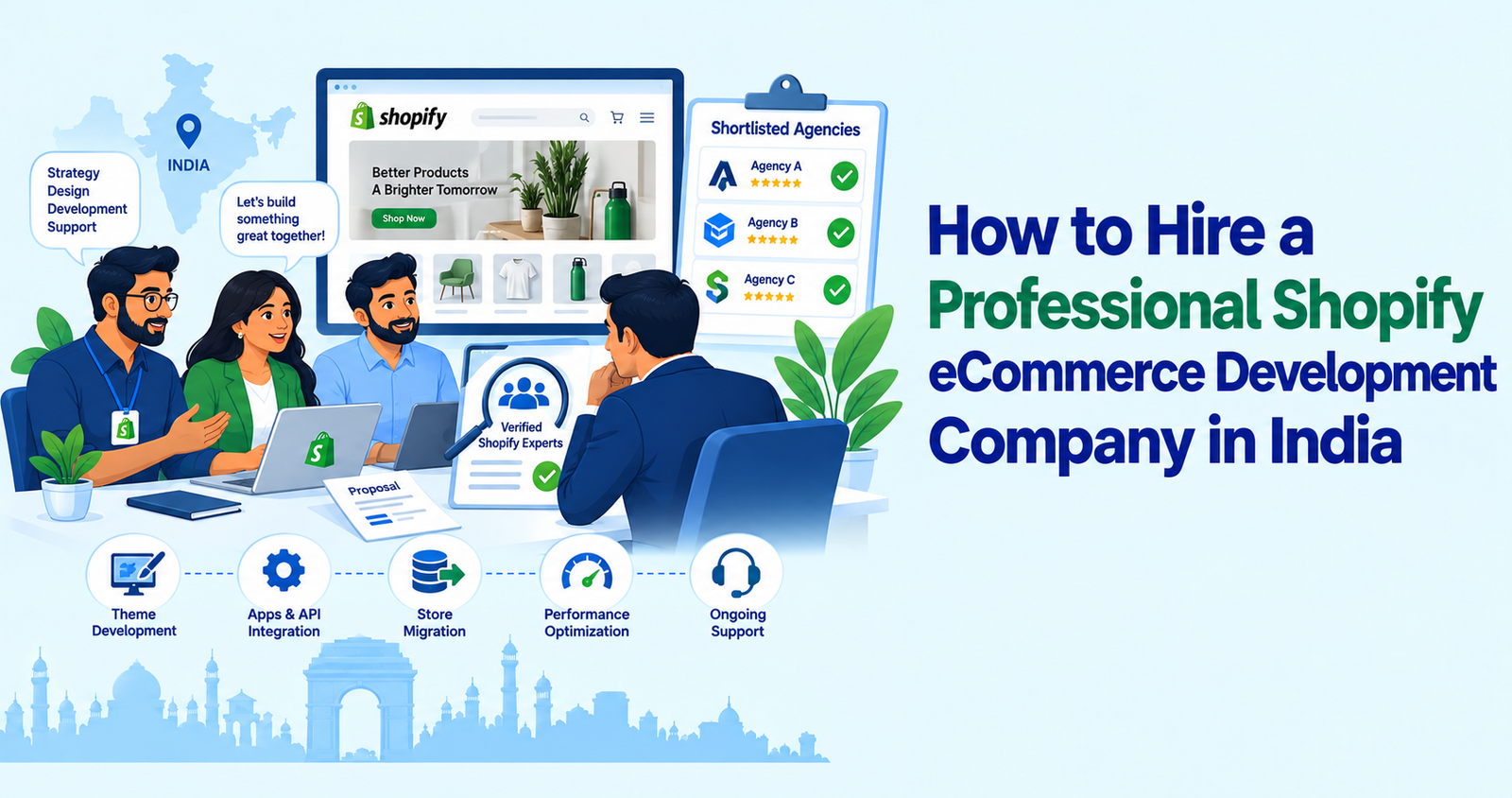
Hiring a Shopify ecommerce development company in India should be treated as a business and technology decision, not a search for the lowest website package. The selected company may influence brand presentation, catalogue structure, customer journeys, integrations, migration quality, analytics, search foundations and the ease with which your team manages the store after launch. A poor fit can create fragile code, excessive app costs, unclear ownership and repeated rework.
India offers a broad provider market, from small Shopify studios to multidisciplinary agencies and enterprise integration teams. Choice is useful, but service pages and portfolio screenshots do not show who will work on the project or how the company handles scope, quality and handover. A professional hiring process compares evidence against the same business requirements.
This guide provides a structured way to define the project, find qualified companies, evaluate the assigned team, compare proposals, protect access and manage delivery. It also covers Indian ecommerce realities such as COD, supported payment methods, GST-related business inputs, courier coverage, returns, marketplaces and pan-India fulfilment. These workflows should be discovered with the merchant rather than assumed by the developer.
Shopify eCommerce development company in India
Hire the Shopify company that can demonstrate relevant live work, assign a suitable team, translate your requirements into a clear scope, explain native Shopify features versus apps and custom code, test complete customer and operational journeys, protect merchant ownership and provide documented post-launch terms. Shortlist two or three qualified firms, give them the same brief, meet the proposed delivery lead, verify references and score evidence rather than sales presentation. Use paid discovery when migration, integration or business rules remain uncertain.
START WITH A PROJECT BRIEF | Document goals, customers, catalogue, markets, workflows, integrations, content readiness, budget and target launch window.
Define the Business Need Before Searching
A new D2C launch, a retail redesign, a WooCommerce migration, a wholesale portal and an international expansion are different Shopify projects. Define the business problem, primary customers, products, sales channels and operational constraints before contacting companies. Otherwise each provider will estimate a different interpretation.
List essential launch requirements, later improvements and optional ideas. Include catalogue size, variants, search and filters, payment and shipping workflows, customer accounts, subscriptions, integrations, markets, languages, content types and reporting. State which data and assets are ready and who approves decisions.
A good brief does not dictate every technical solution. It explains the required outcome and lets qualified companies propose proportionate architecture. It also makes exclusions and price differences easier to identify.
GIVE EVERY COMPANY THE SAME BRIEF | Comparable inputs produce more meaningful proposals and reduce hidden assumptions.
Choose the Right Type of Shopify Company
| Project situation | Capability to prioritise | Likely delivery model |
| Focused new store | Theme setup, brand adaptation, products and QA | Small Shopify specialist team |
| Custom branded experience | UX, visual design, Liquid and reusable sections | Integrated design and development company |
| Platform migration | Data mapping, redirects, imports and cutover | Migration-led Shopify agency |
| ERP CRM or warehouse connection | API architecture, failures, monitoring and support | Integration-capable technical company |
| Multi-market or B2B programme | Architecture, governance, QA and specialist capacity | Larger multidisciplinary team |
| Ongoing optimisation | Analytics, design, releases and maintenance | Retainer or managed service |
Company size is not proof of suitability. A focused specialist may provide more senior attention for a theme project, while a larger agency may coordinate several disciplines for a migration. Ask whether important skills are internal, subcontracted or supplied through partners.
Build a Qualified India Shortlist
Potential sources include professional referrals, relevant live-store credits, ecommerce networks and the Shopify Partner Directory. Shopify’s directory allows browsing by services, location, price and other criteria. Use it to discover candidates, not to skip evaluation. A listing or partner tier can support credibility, but it does not prove that the company’s current team fits your scope.
Create a longlist using mandatory capabilities and then reduce it to two or three finalists. Review the company website, team visibility, relevant services, live work and clarity of communication. Avoid sending a generic request to dozens of providers because it encourages generic responses.
For India-wide hiring, decide whether in-person workshops, language familiarity or a particular time-zone overlap is genuinely required. Delhi, Mumbai, Bengaluru, Pune, Hyderabad, Chennai, Ahmedabad, Noida and Gurugram all have provider ecosystems, but evidence and accountability matter more than city labels.
SHORTLIST FOR RELEVANCE | Prioritise comparable work and required capability before location, awards or company size.
Verify Comparable Shopify Experience
Ask for two or three live stores comparable in catalogue structure, market, customer journey or technical challenge. Find out what the company actually delivered: strategy, design, theme work, app configuration, custom code, migration, integration or support. A logo wall does not establish contribution.
Test the live stores on mobile and desktop. Review navigation, search, filters, variants, unavailable states, cart behaviour, content consistency and obvious errors. Ask why important decisions were made and what constraints existed. Useful case studies explain the problem, role, approach and measurement method.
Treat revenue, conversion and performance claims carefully unless the provider can explain the period, baseline and other changes. Ecommerce outcomes also depend on product demand, price, marketing and operations.
INVESTIGATE THE PORTFOLIO | Validate live work and the company’s specific responsibility rather than relying on screenshots.
Meet the Assigned Delivery Team
The senior person in the sales meeting may not deliver the project. Request the proposed project lead, UX designer, Shopify developer, QA owner and integration specialist. Ask about allocation, senior review, continuity and subcontractors. Meet the delivery lead before signing.
Designers should understand responsive ecommerce journeys and Shopify’s component model. Developers should be comfortable with Liquid, HTML, CSS, JavaScript, Online Store 2.0 sections, metafields, apps and relevant APIs. QA should test real data and edge cases. The project manager should maintain decisions, risks and approvals.
Give the team one complicated requirement and observe the questions it asks. Structured clarification and honest uncertainty are stronger signals than instant agreement.
HIRE THE TEAM NOT THE LOGO | Confirm names or role profiles, responsibilities, availability and senior oversight.
Assess Theme Liquid and Storefront Skills
Ask the company to distinguish theme configuration, theme customisation, custom theme development and headless commerce. Each has different cost, flexibility and maintenance implications. A professional recommendation uses Shopify’s native capabilities where appropriate and custom development for justified gaps.
Discuss merchant-editable sections, coding standards, duplicate-theme development, version tracking, browser support and code review. Custom logic should handle missing data and avoid unnecessary global scripts. Request an explanation of how future theme and app changes will be assessed.
Be cautious when every requirement receives the same answer: install an app, build everything from scratch or go headless. Architecture should follow business need rather than provider preference.
ASK WHY EACH TECHNICAL LAYER IS NEEDED | Separate native features, apps, theme changes and bespoke code in the proposal.
Evaluate UX Branding and Mobile Commerce
A professional company designs complete journeys, not only an attractive homepage. Review information architecture, menus, collection hierarchy, search, filters, product cards, product information, variants, delivery communication, cart feedback, forms and support content.
Mobile layouts should be tested with realistic product names, sale prices, unavailable options, multiple promotions and long content. Accessibility basics such as readable contrast, keyboard access, focus visibility, labels and descriptive alternatives should be included in the quality approach.
Ask the designer to explain how components help customers find, compare or decide. Decorative effects should not obscure information or add avoidable performance cost.
REVIEW COMPLETE CUSTOMER TASKS | Approve responsive discovery, product, cart and support journeys rather than isolated mock-ups.
Check Apps API and Integration Capability
Apps can add reviews, subscriptions, loyalty, search, bundles, automation and returns. They also add fees, permissions and vendor dependency. The company should compare native features, reputable apps and custom code, then document purpose, owner, cost and removal risk.
For ERP, CRM, POS, warehouse, courier, marketplace or accounting connections, request a written data flow. It should identify source of truth, identifiers, update frequency, authentication, retries, duplicates, cancellations, refunds, partial fulfilment, monitoring and responsibility during external failure.
Confirm experience with the relevant API or allocate discovery time. Integration estimates should state assumptions about documentation, sandbox access and third-party support.
MAP DATA AND FAILURE STATES | Do not approve an integration based only on a successful ideal-path demonstration.
9 Test Indian Ecommerce Operations Knowledge
An India-focused provider should ask how the business sells across D2C, retail, wholesale, B2B and marketplaces. Pan-India fulfilment, courier serviceability, COD eligibility, return-to-origin risk, shipping thresholds, local delivery, customer support and inventory across locations influence the storefront.
Payment recommendations must reflect supported providers, merchant eligibility, verification and current terms. GST-related invoices, business inputs and accounting workflows should be scoped with the merchant and its advisers. The developer should not invent tax policy.
Ask candidates to walk through a real order from product selection to fulfilment, cancellation, refund and reconciliation. Operational understanding is more useful than simply listing Indian apps.
USE REAL ORDER SCENARIOS | Test payment, COD, shipping, returns, inventory and customer communication knowledge.
10 Review Migration and SEO Preservation
Migration requires mapping products, customers, orders, pages, blogs, media, metafields and other records. Some passwords or legacy features may not transfer directly. Ask for sample imports, exception handling, record reconciliation and a final cutover plan.
Organic continuity requires an inventory of important URLs, relevant redirects, internal-link updates, content preservation and post-launch monitoring. Analytics, consent settings and conversion events also require validation. Redirecting every old URL to the homepage is rarely a responsible plan.
The proposal should state record types and quantities, excluded cleanup, content freeze, domain responsibilities and approval owners. SEO responsibility must be explicit rather than assumed under development.
REQUIRE A MIGRATION CHECKLIST | Protect data, URLs, analytics and operations with named owners and acceptance criteria.
11 Use Paid Discovery for Complex Projects
Paid discovery is useful when requirements, data or integrations are uncertain. The company can review systems, run workshops, inspect exports and produce a requirements document, component inventory, technical architecture, phased backlog, estimate range and risk register.
Discovery should create reusable outputs owned by the merchant. It is not an indefinite consulting phase. Agree the questions, deliverables, duration and fee. A technical prototype or sample migration may be included when one unknown could materially change architecture or budget.
A provider that offers a confident fixed price for an undocumented integration may be excluding risk rather than removing it.
PAY FOR CLARITY BEFORE SCALE | Resolve high-impact unknowns before committing the full implementation budget.
12 Compare Proposals and Total Ownership Cost
| Proposal area | What must be clear | Risk when vague |
| Scope | Deliverables, quantities, features and templates | Different expectations |
| Assumptions | Content, data, access and client responsibilities | Delay and change requests |
| Exclusions | SEO, migration, integrations, apps, QA and support | Unexpected cost |
| Commercials | Fixed or time-based fees, milestones and taxes | Incomparable totals |
| Third-party cost | Theme, apps, middleware and annual renewals | High ownership cost |
| Acceptance | Review criteria, defects and user approval | Subjective completion |
| Handover | Accounts, code, assets, documents and training | Provider dependency |
Compare like for like. One quote may include discovery, responsive design, migration validation, QA and training while another shows only development. Annualise apps and middleware. Include internal content and approval effort. A transparent estimate range can be more reliable than a fixed number built on hidden assumptions.
NORMALISE EVERY PROPOSAL | Compare one-time work, recurring expenses, exclusions, risk and ownership alongside price.
13 Review Contracts Ownership and Security
The merchant should control the Shopify store, domain, payment accounts, analytics, app subscriptions and essential brand assets. Contracts should address confidentiality, intellectual property, pre-existing components, licences, source files, custom code, subcontractors, data processing and termination.
Use Shopify collaborator accounts and appropriate permissions for partner access. Shopify describes collaborator access as permission-controlled access for Partners, and store owners can manage or remove it. Avoid sharing the owner password. Review access at milestones and remove unnecessary permissions after handover.
No provider can guarantee absolute security. Ask how credentials are handled, access is reviewed, sensitive data is limited and incidents are reported. Obtain legal advice when contract or data risk justifies it.
KEEP MERCHANT CONTROL | Create accounts in the business name and document permissions, ownership, licences and offboarding.
14 Verify Project Management and Communication
Ask which platform is used for tasks, files and approvals; how often status is reported; and how risks are escalated. Confirm meeting cadence, time-zone overlap and the accountable lead. A redacted project plan, status report or handover example provides better evidence than a communication promise.
The plan should show client dependencies such as product data, photography, policy content, payment verification, app accounts and feedback. Name decision-makers and approval windows. Maintain a decision log so different stakeholders do not issue contradictory instructions.
For distributed India teams, communication quality matters more than physical proximity. Local workshops can help, but remote delivery can also succeed with visible work and disciplined decisions.
AGREE THE WORKING RHYTHM | Define channels, meetings, approval windows, reporting and escalation before kickoff.
15 Inspect QA Launch and Support Terms
QA should cover navigation, search, filters, products, variants, pricing, discounts, cart, forms, accounts, shipping communication, payment preparation, notifications, analytics and errors across representative browsers and devices. Migrations and integrations need separate reconciliation and failure tests.
Launch planning includes final data, domains, redirects, app activation, analytics, staff readiness, rollback decisions and hypercare. User acceptance should have named business owners. A date is not evidence of readiness.
Post-launch support may mean defect warranty, prepaid hours, retainer or managed optimisation. Confirm response times, severity, coverage hours, rollover and exclusions. Separate defects from enhancements.
REQUIRE LAUNCH EVIDENCE | Approve customer journeys, operational workflows and ownership checks before go-live.
16 Speak to References and Run a Paid Test
For a substantial project, ask one or two relevant former clients about scope control, communication, problem handling, handover and post-launch response. Respect confidentiality and do not expect access to sensitive commercial data. References complement your evaluation rather than replacing it.
A small paid test can evaluate a company when technical fit remains uncertain. Use a contained task such as auditing a component, planning one integration or building a representative section. Define the output, time, payment, confidentiality and ownership. Do not request unpaid speculative work.
Judge reasoning, code or design quality, communication and documentation. A successful small task does not prove capacity for a full programme, but it can expose major fit issues.
VERIFY WITH REAL WORK | Use references and a fair paid exercise for high-risk engagements.
17 Use a Weighted Vendor Scorecard
| Criterion | Weight | Evidence |
| Requirements understanding | 15% | Questions, assumptions and proposed approach |
| Relevant Shopify work | 15% | Comparable live stores and specific contribution |
| Assigned team | 15% | Roles, availability and senior review |
| Technical capability | 15% | Theme, Liquid, apps, APIs, migration and QA |
| UX and mobile | 10% | Complete journeys and responsive evidence |
| Delivery process | 10% | Plan, reporting, decisions and launch |
| Ownership and support | 10% | Access, contract, handover and service terms |
| Commercial value | 10% | Transparent price and recurring cost |
Agree weights before final presentations. Score each company from one to five, multiply by the weight and record evidence. Discuss major differences between stakeholders. A low commercial score may be acceptable if risk and capability are strong; a high sales impression should not compensate for weak ownership terms.
SCORE THE SAME EVIDENCE | Make the final decision traceable rather than relying on preference or presentation style.
18 Onboard the Selected Shopify Company
Begin with a signed scope, project plan, responsibility matrix, access list and decision process. Create accounts in the merchant’s name, provide collaborator access with limited permissions and organise brand, content and data inputs. Confirm milestones and acceptance criteria.
Hold a kickoff covering goals, customers, operational workflows, known risks, communication and launch dependencies. Convert open questions into assigned actions. Establish how designs, builds and data will be reviewed, and how changes are estimated.
Keep copies of approved designs, contracts, invoices, licences, architecture and handover materials. Good onboarding reduces delay and provides a foundation for post-launch governance.
START WITH CONTROLLED ACCESS AND CLEAR OWNERS | Make decisions, dependencies and responsibilities visible from day one.
19 Set a Realistic Hiring Budget and Payment Plan
Budget should reflect the work and risk rather than an arbitrary package. A lean theme-based store may require a modest professional-services budget, while a custom theme, migration or integration programme can require several lakhs. Ask the company to separate discovery, design, development, data, integrations, QA, training and support. Shopify subscription, payment processing, premium theme, apps, middleware and content production should appear separately.
Compare first-year ownership cost, not only the launch invoice. Annualise app and integration services, include maintenance and reserve contingency for validated unknowns. A small catalogue with complex product logic can cost more than a large catalogue with clean data and standard customer journeys. The budget should therefore follow scope, not product count or page count alone.
Payment milestones should correspond to useful, reviewable outputs. A practical structure might include an initial amount at contract and discovery, payments after design and build milestones, and a final portion after user acceptance or agreed launch readiness. Exact percentages depend on the engagement. Avoid paying most of the project before meaningful evidence exists, while recognising that a professional company needs reasonable mobilisation and staffing terms.
Confirm invoices, applicable taxes, currency, payment timing, late-payment terms and third-party purchases. If a company buys themes or apps, ensure the merchant owns the licence and renewal account. A lower initial price may be poor value when essential work is excluded or future dependency is created.
CONNECT PAYMENTS TO DELIVERABLES | Approve a commercial schedule that reflects discovery, design, implementation, acceptance and handover.
20 Complete Legal and Procurement Due Diligence
Before signing, verify the legal business name, invoice details, authorised signatory and primary project contact. Larger engagements may justify checking business registration, professional references, data-processing terms, insurance or security questionnaires. The depth of review should match commercial and data risk; a small theme task does not need the same procurement process as an enterprise integration.
The agreement should identify deliverables, responsibilities, assumptions, exclusions, milestones, fees, taxes, change control, acceptance, confidentiality, intellectual property, third-party components, subcontractors, termination and dispute handling. Confirm whether any agency framework, library or reusable component remains licensed rather than transferred, and whether another provider can maintain the completed store.
Data and privacy responsibilities require special attention when customer information, order history or marketing records are accessed. Limit the data shared for development, use appropriate environments and access, and define deletion or return after the engagement. Legal and tax advisers should review matters that require professional interpretation.
Procurement should not become a paperwork exercise disconnected from delivery. Use it to make ownership, accountability and exit conditions clear. The final signed documents should match the sales proposal and statements made during negotiation.
VERIFY THE CONTRACT MATCHES THE PROMISE | Resolve ownership, data, subcontracting, acceptance and termination before work starts.
21 Govern Delivery After the Hiring Decision
Hiring is complete only when the selected company can deliver within a controlled working system. Establish a steering rhythm appropriate to project size: weekly status for active delivery, milestone reviews for designs and builds, and immediate escalation for risks that affect scope, data, security or launch. Reports should show completed work, next actions, decisions required, dependencies and forecast changes.
Maintain one prioritised backlog and one source of approved requirements. When stakeholders request changes, record the reason, impact and decision. Avoid giving developers conflicting instructions through separate chats. The merchant project owner should consolidate business feedback, while the company lead should translate it into specific work and acceptance conditions.
Review quality throughout the project rather than waiting for final QA. Test representative product data early, approve responsive components with real content, validate integration events in stages and run sample migration reports. Incremental evidence makes problems less expensive to correct.
Track ownership at each milestone. Store files, credentials, licences, architecture and decisions in agreed locations. Review collaborator permissions as roles change. Before launch, confirm training, handover, support contacts and an improvement backlog. This governance protects the value of the hiring decision after the contract is signed.
MANAGE BY EVIDENCE AND DECISIONS | Keep progress, risks, approvals, access and ownership visible through every phase.
15 Questions to Ask Every Finalist
- Which live Shopify projects are most comparable, and what exactly did your company deliver?
- Who will work on our project, and what senior review and availability will they have?
- Which requirements use native Shopify, apps, theme changes or custom code, and why?
- What assumptions, dependencies and exclusions are included in your estimate?
- How will product data, content, variants and filters be prepared and validated?
- How do you evaluate app cost, permissions, performance and removal risk?
- How will integrations handle retries, duplicates, refunds and external downtime?
- What is the migration, redirect, analytics and cutover plan?
- Which browsers, devices, workflows and edge cases are included in QA?
- How are milestones approved and scope changes estimated?
- Who owns the store, accounts, code, designs, licences and documentation?
- How will collaborator access and sensitive information be controlled?
- What training, warranty and post-launch support are included?
- What could change the price or schedule, and how will it be documented?
- Which reference or paid discovery step can verify the highest-risk capability?
ASK THE SAME QUESTIONS | Written answers expose gaps and make finalists easier to compare.
Red Flags When Hiring in India
- Guaranteed revenue, rankings, conversion rates, perfect speed, security or uptime.
- A complex fixed quote produced before requirements, data or systems are reviewed.
- Refusal to identify the assigned team, accountable lead or subcontractors.
- Portfolio claims that do not explain the provider’s contribution.
- One technical answer for every requirement without comparing alternatives.
- No written assumptions, exclusions, acceptance criteria or change process.
- Provider ownership of the merchant store, domain, payments or essential subscriptions.
- Extremely low pricing supported by copied themes, unlicensed assets or unclear labour.
- Pressure to pay a large amount before useful milestones or access controls exist.
PAUSE WHEN EVIDENCE IS WEAK | Resolve material concerns in writing before signing or paying a large deposit.
Final Recommendation
The best Shopify ecommerce development cost company in India is not automatically the largest, cheapest or nearest. It is the provider whose evidence, assigned team, process and commercial terms fit the project. A professional company will explain trade-offs, reduce uncertainty, test rigorously and leave the merchant in control.
Budget Web Design provides Shopify website design and development services for businesses in Delhi and across India, including store planning, theme setup and customisation, custom sections, redesign, migration, app and API integration, product-page optimisation, technical SEO foundations, maintenance and support. Engagements are scoped against the actual requirement rather than a generic package.
DISCUSS YOUR SHOPIFY PROJECT IN INDIA | Visit budgetwebdesign.in and share your catalogue, current platform, features, integrations, budget and preferred launch window.
Frequently Asked Questions
1 How do I find a Shopify development company in India
Use relevant referrals, live-store research and the Shopify Partner Directory, then evaluate evidence, team and process independently.
2 How many Shopify companies should I compare
Two or three qualified finalists are usually enough when each receives the same brief and questions.
3 Is a Shopify Partner automatically the best choice
No. Directory presence or tier can support discovery, but relevant work, assigned team, process and contract fit still require verification.
4 Should I hire a local or remote Indian company
Choose based on capability and accountability. Local workshops can help, while disciplined remote teams can also deliver effectively.
5 How much does a Shopify company in India charge
Price depends on design, catalogue, custom features, migration, integrations, QA and support. Request an itemised scope-based estimate.
6 Should I choose the lowest quotation
Not automatically. Compare exclusions, recurring costs, ownership, QA and likely change before deciding.
7 What technical skills should the company have
Relevant skills may include Liquid, responsive frontend development, Online Store 2.0, metafields, apps, APIs, migration and testing.
8 Can an Indian Shopify company handle international stores
Many can, but verify direct evidence with markets, currencies, content, payments, shipping and operational requirements.
9 How should the company access my store
A Shopify Partner should normally request collaborator access with only the permissions needed. Do not share the owner password.
10 What should the proposal include
It should state deliverables, assumptions, exclusions, timeline, responsibilities, price, third-party costs, acceptance, ownership and support.
11 Do I need paid discovery
It is useful when integrations, migration data or business rules are uncertain enough to affect architecture and price.
12 Who should own the Shopify store
The merchant should control the store, domain, payments, analytics, subscriptions and essential assets.
13 What post-launch support should I request
Confirm warranty, response hours, severity, included capacity, exclusions and pricing for maintenance or optimisation.
14 Can a company guarantee sales or rankings
No responsible company should guarantee them. Results depend on products, demand, pricing, marketing, operations and more.
15 How can Budget Web Design help
Budget Web Design can assess the requirement and provide appropriate Shopify design, development, migration, integration, optimisation or support services.