

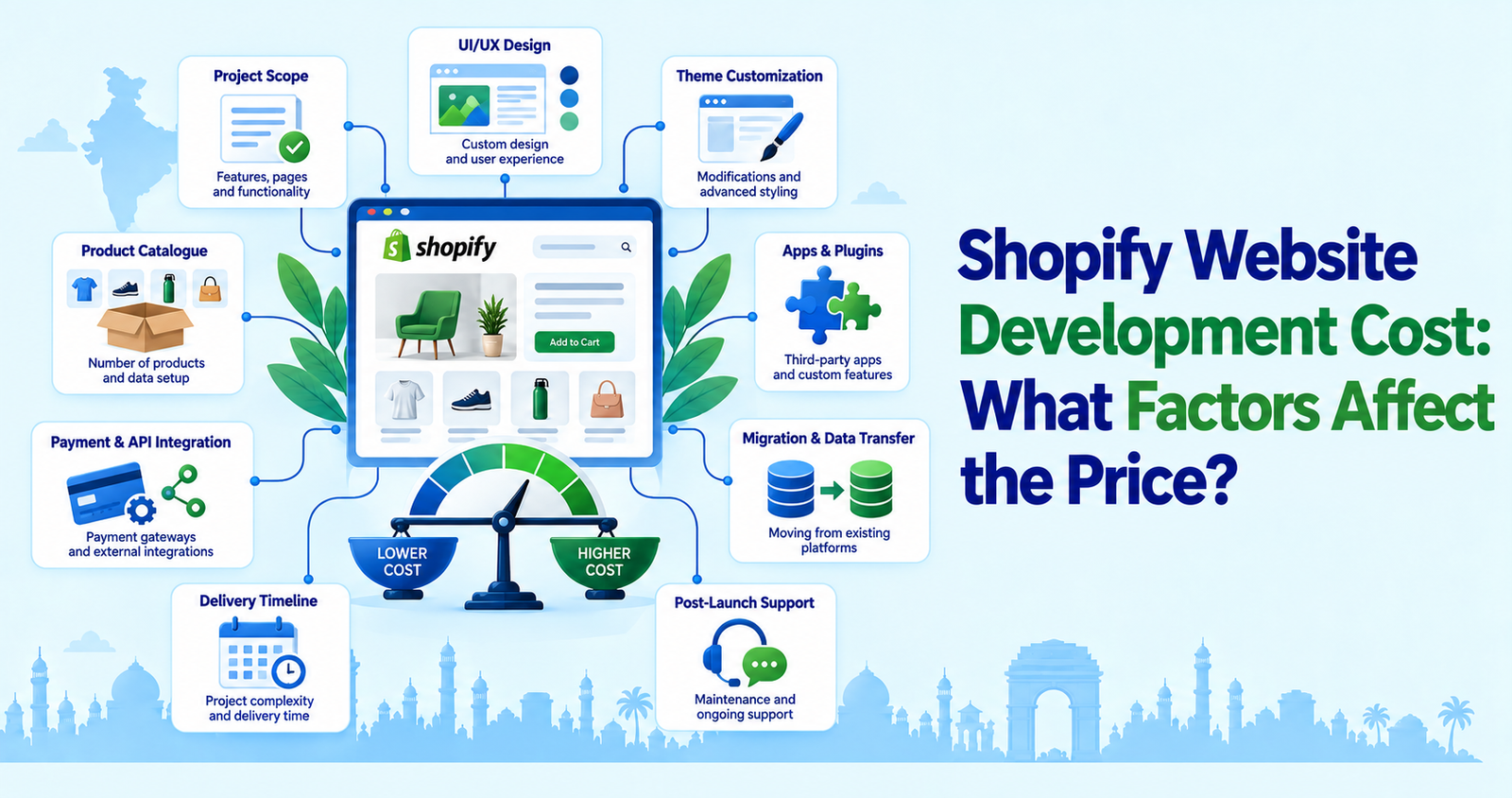
The price of a Shopify website is shaped by the work required to turn a business model into a reliable ecommerce system. A store using a standard theme, prepared product data and native Shopify features can be launched with a relatively lean budget. A distinctive storefront with custom components, migration, ERP integration, subscriptions, B2B logic or several markets requires more research, design, engineering and testing. The difference is not simply the number of pages.
A useful quotation explains which factors drive effort, which assumptions could change the price and which recurring expenses remain after launch. Without that detail, two proposals that appear similar may include very different levels of design, data work, QA, support and ownership. Choosing the lowest total can then produce app dependency, repeated change requests or expensive reconstruction.
This guide focuses on the price drivers rather than publishing one universal rate. Indicative Indian planning bands are included where helpful, but they are not fixed quotations. Shopify plans, themes, apps and payment terms can change and should be verified before purchase. The final development price should follow a written scope and discovery of the store’s actual requirements.
Shopify Website Development Cost India
The main factors affecting Shopify website development cost are project scope, design originality, theme choice, unique templates, catalogue quality, product options, custom functionality, apps, integrations, migration, content, SEO requirements, performance and accessibility expectations, testing depth, timeline, provider model and post-launch support. Complexity increases when more systems, data, customer states and business rules must work together. Cost can be controlled by prioritising launch essentials, preparing content and data early, using native Shopify capabilities appropriately and documenting assumptions before development begins.
IDENTIFY THE COST DRIVERS | Share your catalogue, customer journeys, integrations, content status and operational requirements before requesting a final estimate.
Price Factor Summary
| Factor | Lower cost condition | Higher cost condition |
| Scope | Focused launch requirements | Multiple markets, channels or workflows |
| Design | Theme adaptation | Bespoke UX and component system |
| Catalogue | Clean structured data | Inconsistent records and complex variants |
| Functionality | Native Shopify features | Custom product, pricing or cart logic |
| Apps | Small documented stack | Many overlapping or usage-priced apps |
| Integrations | Manual or simple export | Real-time multi-system synchronisation |
| Migration | Small clean dataset | Large custom platform and SEO-sensitive URLs |
| Quality | Standard journey checks | Formal performance, accessibility and multi-device testing |
| Delivery | Realistic schedule and clear approvals | Urgent launch with parallel work and uncertainty |
| Support | Limited handover | Ongoing optimisation and service commitments |
Business Model and Project Scope
Scope is the strongest price factor because it defines what the store must enable. A simple direct-to-consumer catalogue, a wholesale portal, a subscription business and a retailer with physical stores have different customer rules and operational dependencies. Markets, currencies, languages, locations, customer groups, fulfilment routes and sales channels all add decisions and test cases.
Providers estimate more accurately when requirements are separated into launch essentials, later improvements and optional ideas. A broad instruction such as build a premium ecommerce store forces the supplier to make assumptions. One company may quote theme setup while another includes discovery, bespoke design, data migration and training.
Document business goals, primary customers, catalogue size, order workflows, content ownership and launch constraints. State what success means without requesting guaranteed commercial results. Clear scope does not eliminate change, but it makes its effect visible.
DEFINE THE STORE AS A BUSINESS SYSTEM | Describe customers, products, operations and integrations instead of listing pages only.
Theme Setup Theme Customisation or Custom Theme
Theme setup uses existing settings and sections. Theme customisation modifies selected layouts or behaviours. A custom theme creates a tailored component and template system. Each level requires more design, coding and QA. A paid theme licence can reduce development when it already supports the required journeys, but its purchase price is separate from implementation.
Heavy changes to a theme can approach the cost of custom development while making future updates harder. The provider should compare native features, focused changes and a custom approach before recommending one. Ask which theme files will change, how content remains merchant-editable and how updates will be reviewed.
Custom development should have a business or brand reason. It is not automatically better. For many growing businesses, a strong theme plus carefully designed sections produces the right balance of speed, control and cost.
CHOOSE THE RIGHT DEVELOPMENT LEVEL | Pay for custom code only where native theme capabilities do not meet an important requirement.
Design Originality and UX Depth
Design cost rises with the number of journeys, templates, states and review rounds. Basic adaptation may cover colours, typography, imagery and theme layouts. Deeper work can include research, information architecture, wireframes, design concepts, responsive screens, prototypes, component states and usability evaluation.
A homepage is only one part of ecommerce UX. Navigation, search, collection filters, product comparison, variants, delivery information, cart feedback, forms, account flows and support content influence the estimate. Mobile states, unavailable products, discounts, errors and long content require deliberate design.
If brand identity, photography, iconography or copywriting is incomplete, those tasks create a separate workstream. Confirm the number of concepts and revision rounds. Unlimited revision promises often hide weak boundaries rather than reducing cost.
COUNT JOURNEYS AND STATES | Define the complete design deliverables rather than pricing only a homepage and product page.
Number of Unique Templates and Reusable Sections
Shopify can display many URLs through a small number of templates, so page count alone is misleading. One product template may serve hundreds of products, while different product categories may require distinct specifications, size tools, bundles or content structures. Campaign landing pages, editorial collections and brand stories can add templates and sections.
Reusable Online Store 2.0 sections allow merchants to build pages from controlled components. Each section needs schema settings, responsive behaviour, content limits, empty states and testing. The investment is higher than a hard-coded block but reduces future developer dependency.
Ask for a template and component inventory. It should identify which items are native, configured, modified or custom. This exposes duplicated design and prevents the same component being priced repeatedly.
ESTIMATE THE COMPONENT SYSTEM | Price unique layouts and behaviours, not the total number of product or content URLs.
Product Catalogue Size and Data Quality
Catalogue size affects imports, validation and content work, but data quality has greater influence. Structured products with consistent titles, descriptions, media, SKUs, prices, inventory, categories and metafields can be processed efficiently. Incomplete spreadsheets, duplicate records and inconsistent variants require manual cleanup and business decisions.
A small catalogue can still be complex when products have many options, compatibility rules, bundles, subscriptions, personalisation or technical specifications. Advanced filters and collection rules depend on reliable product attributes. Image cropping, naming and alternative text also require responsibility and time.
Provide sample data before accepting a quote. Clarify whether the supplier will import all products, a defined quantity or a sample while training the internal team. State who validates prices, variants and inventory.
AUDIT DATA BEFORE PRICING | Clean product records reduce manual work, launch risk and unexpected change requests.
Custom Features and Business Rules
Features cost more when they introduce many conditions or interact with other parts of the store. A simple informational size guide differs from a recommendation engine. A standard discount differs from customer-specific pricing, tiered quantities or bundle rules. Product configurators, bookings, subscriptions, wishlists and loyalty programmes also have different technical routes.
For each feature, define the customer action, business rule, data source, error state and administrative need. Then compare a native feature, suitable app and custom development. An app may lower initial cost but add subscription and dependency. Custom code may offer control but requires testing and maintenance.
Prototypes or technical discovery can reduce uncertainty for unusual requirements. A responsible estimate identifies assumptions rather than hiding them inside a fixed figure.
DESCRIBE BEHAVIOUR NOT FEATURE NAMES | Provide examples, rules and exceptions so the provider can estimate the real workflow.
Shopify Apps and Recurring Software
Apps extend reviews, subscriptions, search, bundles, loyalty, returns, feeds and automation. Their commercial models may be free, fixed monthly, tiered by orders or based on usage. Development cost includes selection, configuration, styling, data setup, testing and sometimes migration from an older app.
A large app stack can create overlapping scripts, permissions and vendor dependencies. Annualise fees when comparing alternatives and identify what happens when an app is removed. A low build quote can become expensive if it relies on several paid apps for basic behaviour.
Maintain an app register containing purpose, owner, recurring fee, permissions, data stored, storefront impact and exit risk. Review native Shopify capabilities before purchasing another tool.
COMPARE FIRST YEAR APP COST | Add setup effort and twelve months of fees to the initial development price.
API and Third Party Integrations
ERP, CRM, POS, warehouse, courier, accounting and marketplace integrations can become the largest technical cost. Effort depends on API quality, field mapping, authentication, update frequency, data volume, rate limits and exception handling. One-way scheduled exports cost less than near-real-time two-way synchronisation.
A proper estimate defines the source of truth, identifiers, retries, duplicate prevention, cancellations, refunds, partial fulfilment, monitoring and responsibility during external downtime. Middleware can shorten the build but introduces subscription and platform dependency. Direct integrations need ongoing maintenance when APIs change.
Third-party documentation, sandbox access and vendor response times affect schedule and price. Complex integration should usually begin with discovery and sample transactions.
MAP EVERY DATA FLOW | List events, fields, direction, frequency, errors and system ownership before requesting a fixed price.
Migration Volume and Legacy Complexity
Migration involves more than moving products. Customer records, order history, pages, blogs, reviews, gift cards, discounts, images and custom fields may require mapping. Legacy functionality may need a Shopify app, a custom alternative or an operational change. Customer passwords may not transfer directly.
Data cleanup, trial imports, reconciliation and final cutover create effort. SEO-sensitive migrations also require URL inventory, redirects, internal-link updates, metadata review and post-launch monitoring. The source platform’s export quality affects automation.
A sample migration helps measure exceptions before the full estimate is fixed. The proposal should state record types, quantities, excluded cleanup, content freeze and validation owner.
TEST REPRESENTATIVE DATA | Use real source exports to uncover mapping gaps and manual correction before launch.
Content Product Photography and Brand Assets
Development may be ready while the store is not. Product copy, collection descriptions, policy pages, imagery, video, size charts, translations and brand assets require production and approval. If the provider creates or uploads them, the quotation must include quantities and revision limits.
Content entry can be estimated per item, by hours or within a capped batch. Photography and video add planning, production and editing. Stock imagery and fonts still require appropriate licences. Internal staff time is also a cost even when it does not appear on a supplier invoice.
A content matrix should identify every template, required input, owner and deadline. Prepared content reduces rework because designs can be validated with realistic material.
ASSIGN CONTENT OWNERS | Decide who writes, produces, uploads and approves every launch asset.
SEO Analytics and Tracking Requirements
Basic SEO foundations include crawlable architecture, headings, titles, internal links, image handling and sensible templates. More involved work can add keyword-informed collection planning, content briefs, redirect mapping, structured data review and migration monitoring. Ongoing content or authority development is a separate service.
Analytics requirements can include GA4, advertising pixels, consent controls, custom events, dashboards and server-side or third-party tools. Each must be configured and tested against real journeys. Tracking complexity rises when multiple markets, campaigns or consent rules are involved.
No provider should guarantee rankings or perfect attribution. Define the implementation and validation deliverables in the scope.
SEPARATE SEO FOUNDATIONS FROM ONGOING SEO | Specify architecture, migration, content and measurement responsibilities clearly.
Performance Accessibility and Browser Support
Performance work may cover image delivery, fonts, JavaScript, apps and third-party scripts. Expectations should be based on representative home, collection and product pages using real content. Perfect scores cannot be guaranteed because devices, networks and external services affect measurements.
Accessibility can range from development best practices to a formal audit and remediation programme. Keyboard access, focus states, contrast, labels, alternatives and semantic structure require design, development and QA. Browser and device support also determines the test matrix.
Higher assurance costs more because more states are inspected, defects are documented and fixes are retested. Agree the target and evidence before development.
DEFINE QUALITY LEVELS | Convert broad expectations into representative pages, test methods and acceptance criteria.
Checkout Payments Shipping and Tax Workflows
Payment, shipping and tax setup is influenced by merchant eligibility, markets, providers, product types and fulfilment rules. A basic store may use straightforward rates and one payment provider. Complex projects may need COD conditions, serviceability checks, multiple locations, local delivery, international duties or specialised fulfilment communication.
The provider can configure supported options, but legal, tax and accounting decisions remain with the business and its advisers. Gateway onboarding, processing, refunds and chargebacks are operational costs, not development fees. Current Shopify and provider terms should be verified.
Test realistic orders, discounts, addresses, shipping thresholds and refund cases. Edge cases increase effort but prevent operational problems after launch.
DOCUMENT ORDER SCENARIOS | Include payment, COD, shipping, fulfilment, cancellation and refund conditions in the scope.
Testing User Acceptance and Launch Risk
Quality assurance covers navigation, search, filters, products, variants, pricing, discounts, cart, forms, accounts, shipping messages, payment preparation, notifications, analytics and errors. Migrations and integrations require record reconciliation and failure testing. More devices, markets and workflows create more cases.
User acceptance testing requires business owners to validate prices, policies, inventory, tax inputs and operational behaviour. Launch may include DNS, final imports, redirects, app activation, staff readiness and a hypercare period. Urgent dates can require parallel work and extra coordination.
A low quote may exclude formal QA and rely on the merchant to find defects. Ask for the test plan, supported environments, defect process and launch checklist.
PRICE QUALITY ASSURANCE EXPLICITLY | Confirm journeys, devices, owners and launch evidence rather than accepting testing as one vague line.
Timeline Urgency and Approval Process
A realistic schedule lets design, development, content and testing occur in sequence. Compressed timelines can require more people, parallel work, faster decisions and out-of-hours launch support. This may increase cost and still introduce risk. Delays also occur when content, access or feedback is late.
Name one decision owner and set approval windows. Consolidated feedback reduces repeated revisions. If several departments must approve work, include those dependencies in the plan. A fixed deadline tied to an event should have a reduced minimum launch scope and contingency.
Providers should distinguish elapsed calendar time from billable effort. A project can pause for client inputs without reducing the work required.
ALIGN SCOPE WITH THE DATE | Protect essential customer and operational journeys before adding optional launch features.
Provider Experience Team and Delivery Model
Freelancers, specialist studios and larger agencies have different cost structures and capabilities. Price can reflect seniority, specialist roles, project management, QA and capacity. A lower rate is not necessarily lower total cost if work takes longer or requires rework. A larger team is not automatically better for a focused project.
Ask who will perform discovery, design, development, QA and support. Confirm senior oversight and subcontracting. Relevant evidence matters more than a broad service list or location alone. Delhi-based access may help workshops, while remote specialists can also deliver effectively.
Fixed-price, hourly, retainer and dedicated-team models distribute risk differently. Choose according to scope certainty and ongoing demand.
EVALUATE THE ASSIGNED TEAM | Compare relevant capability, accountability and included process alongside the headline rate.
Ownership Documentation and Training
The merchant should control the Shopify store, domain, payments, analytics, app subscriptions and essential assets. Contracts should address custom code, design files, licences and third-party components. Weak ownership terms can create future cost when another provider must reconstruct missing work.
Documentation may include theme notes, app register, integration architecture, content guidance, access inventory and launch record. Training can be live, recorded or written. It helps staff manage products, collections, content, discounts and orders without unnecessary support tickets.
These deliverables add effort but reduce dependency and improve maintainability. Confirm their format and depth before comparing quotations.
CTA: INCLUDE HANDOVER IN THE PRICE | Treat ownership, documentation and training as project deliverables, not informal promises.
Post Launch Support and Change Frequency
Support can mean a defect warranty, ticket-based maintenance, prepaid hours, a retainer or proactive optimisation. Each model has different coverage and cost. Ask about response hours, severity levels, included capacity, rollover and exclusions.
Stores with frequent campaigns, integrations or internal change need more ongoing support than stable catalogues. Apps, themes and APIs also evolve. Set an annual reserve for updates, operational fixes and evidence-led improvements.
Avoid purchasing a large retainer if the business cannot prepare briefs and approvals. Equally, a critical integration may justify guaranteed capacity. The correct model reflects risk and change frequency.
BUDGET BEYOND LAUNCH | Include subscriptions, maintenance and a realistic improvement reserve in first-year ownership cost.
Requirements Uncertainty and Change Control
Uncertainty has a price because the provider must either investigate it, exclude it or carry contingency. A request such as connect our ERP cannot be estimated responsibly without knowing the API, data fields, events, authentication and exception rules. The same applies to complex migration data, product configurators and business-specific discount logic. An immediate fixed number may look convenient while relying on assumptions that later become change requests.
Paid discovery converts uncertainty into evidence. It can produce requirements, journey maps, a component inventory, integration architecture, sample migration, risk register and phased estimate. A small technical prototype can also test a difficult assumption before the full build is committed. The discovery output should belong to the merchant and be usable in implementation or supplier comparison.
After approval, change control protects both parties. New requirements should be documented with their effect on price, schedule and dependencies before work begins. This does not prevent sensible iteration; it prevents informal requests from accumulating into disputed effort. Maintain a decision log and separate defects from enhancements.
A contingency allowance should reflect known risk rather than act as a random percentage. A straightforward prepared theme project needs less contingency than an integration-led migration with incomplete documentation.
REDUCE UNKNOWN WORK FIRST | Use discovery, sample data and prototypes before converting complex requirements into a final commitment.
Location Currency Taxes and Procurement Terms
Provider location can influence rates, but it does not determine value by itself. A Delhi freelancer, specialist Indian studio and international agency may offer different seniority, availability, overhead and service breadth. Compare who is assigned, the work included and the total effort. A lower hourly rate can cost more when communication, rework or missing expertise extends delivery.
Currency also affects the budget when themes, apps, middleware or specialists are billed outside India. Allow for conversion, bank or card charges and exchange movement. Commercial prices may be displayed monthly but discounted for annual billing; compare the same billing period. Verify whether quoted professional fees include applicable taxes and whether third-party licences are paid directly by the merchant.
Payment schedules can change risk and cash flow. Milestones should correspond to useful outputs such as discovery approval, design approval, development completion, user acceptance and launch. Avoid paying for unverified completion or allowing the provider to purchase essential accounts in its own name. Larger businesses may also incur procurement, legal, security or vendor-onboarding effort.
NORMALISE COMMERCIAL TERMS | Compare the same currency, tax treatment, billing period, milestones and ownership before choosing a proposal.
How the Factors Combine Into an Estimate
| Estimation layer | Questions to answer | Effect on price |
| Foundation | Plan, theme, markets, catalogue and standard configuration | Creates the base implementation effort |
| Design system | Templates, components, states and revisions | Adds research, design and responsive work |
| Custom behaviour | Business rules, apps and bespoke code | Adds engineering and maintenance |
| Data and migration | Records, cleanup, mapping and redirects | Adds automation, validation and cutover work |
| Connections | Systems, events, errors and monitoring | Adds architecture, API work and ongoing risk |
| Quality | Devices, accessibility, performance and acceptance | Adds test coverage and remediation |
| Delivery | Timeline, project management, training and support | Adds coordination and service commitments |
A practical estimate is the sum of effort for these layers plus third-party costs and contingency for known uncertainty. The provider should state assumptions and show which items are fixed, estimated or excluded. Complex unknowns can be reduced through paid discovery, a prototype or a sample migration before the main build.
ASK FOR AN ITEMISED ESTIMATE | Separate one-time work, recurring software, optional enhancements and uncertainty.
Indicative India Budget Scenarios
| Scenario | Indicative professional services | Why the range changes |
| Lean theme based launch | ₹35,000 to ₹80,000 | Content readiness, product count and small custom changes |
| Branded ecommerce store | ₹80,000 to ₹2,50,000 | UX depth, custom sections, merchandising and QA |
| Custom theme project | ₹2,50,000 to ₹6,00,000+ | Templates, component system, behaviours and review depth |
| Migration or integration project | ₹1,50,000 to ₹8,00,000+ | Data quality, systems, exceptions, redirects and cutover |
| Plus B2B or headless programme | Discovery based | Architecture, markets, enterprise workflows and ongoing engineering |
These are planning bands, not quotations, and exclude applicable taxes, Shopify plan, payment processing and third-party recurring charges unless a proposal states otherwise. A small catalogue with complex logic can cost more than a large catalogue with clean data and standard behaviour.
USE THE CLOSEST SCENARIO AS A START | Adjust for design, data, functionality, systems, quality and delivery risk.
Red Flags in a Low Shopify Development Quote
- No written assumptions, exclusions, quantities or acceptance criteria.
- A complex migration or integration priced before sample data and API documentation are reviewed.
- Premium design promised without defining templates, mobile states or revision rounds.
- Apps and recurring costs omitted from the ownership calculation.
- SEO, analytics, accessibility, performance and testing described only as included.
- The provider controls the merchant store, domain, payment or essential subscriptions.
- Unlimited revisions, guaranteed rankings, revenue, speed or security claims.
- No named delivery lead, QA process, handover or post-launch terms.
A low quote can be valid when scope is genuinely lean. The concern is a low number supported by unclear responsibilities or unrealistic promises. Resolve material gaps in writing before selection.
COMPARE SCOPE BEFORE TOTALS | Normalise every proposal against the same requirements and first-year costs.
Final Recommendation
Shopify website development price is a consequence of scope, not a standard package label. The most useful estimate shows how business rules, design, data, systems, quality and delivery responsibilities translate into work. It also separates platform and third-party expenses from professional fees.
Budget Web Design provides Shopify website design and development services for Delhi and India-based businesses, including theme setup, customisation, custom sections, redesign, migration, apps, API integrations, product-page optimisation, technical SEO foundations, maintenance and support. Final pricing is prepared after reviewing the real requirements and dependencies.
REQUEST A FACTOR BASED SHOPIFY QUOTE | Visit budgetwebdesign.in and share your catalogue, current platform, required features, integrations, content status, budget and launch window.
Frequently Asked Questions
1 What is the biggest factor affecting Shopify website cost
Project scope is usually the largest factor because it determines the required journeys, features, systems, data and testing.
2 Does the number of products affect the price
Yes, but data quality and variant complexity often matter more than the raw product count.
3 Is a paid Shopify theme included in development cost
Usually not. The licence and professional configuration should be shown as separate items.
4 Why does custom design cost more
It requires research, wireframes, responsive components, multiple states, review and tailored theme development.
5 Do Shopify apps reduce development cost
They can reduce initial engineering, but add configuration, recurring fees and vendor dependency.
6 Why are integrations expensive
They require data mapping, authentication, exception handling, monitoring and coordination with external systems.
7 What makes migration cost increase
Poor source data, custom fields, feature replacement, large record volumes, redirects and difficult cutover requirements.
8 Is content entry included in Shopify development
Only when the proposal says so. Confirm quantities, formats, responsibilities and revision limits.
9 Does urgent delivery increase the price
It can, because compressed schedules may require parallel staffing, faster approvals and additional coordination.
10 How does QA affect the budget
More devices, markets, workflows and formal acceptance checks increase testing and retesting effort.
11 Should I choose a freelancer or agency based on price
Choose according to required capability, accountability and scope. Compare total effort and risk, not hourly rate alone.
12 Can Shopify development have a fixed price
Yes when scope and assumptions are stable. Complex unknowns may require paid discovery first.
13 How can I reduce the cost safely
Prioritise launch essentials, prepare content and data, use native capabilities and control post-approval changes.
14 What costs continue after launch
Shopify, apps, payment processing, domains, services, maintenance and future improvements may continue.
15 How can Budget Web Design provide an estimate
Share business goals, products, design needs, features, systems, content status and timing for a scope-based quotation.